- tyler@kirail.com
- +86 15603721115
In metal forging and ironwork, borax is primarily used as a flux—a chemical cleaning agent applied to metal surfaces to facilitate shaping, joining, and finishing.
Here is a detailed explanation of why borax is crucial to the forging process:
1. Preventing Oxidation (Scale Formation)
When steel or iron is heated in a forge, it reacts rapidly with atmospheric oxygen to form a layer of iron oxide, commonly known as "scale." At forging temperatures, borax melts and coats the hot metal, creating a protective barrier that shields the surface from air and prevents further oxidation.
2. Dissolving Existing Scale and Impurities
In its molten state, borax is mildly acidic and actively breaks down and dissolves oxides and impurities already present on the metal surface. This cleans the metal, ensuring the blacksmith works with pure, uncontaminated material.
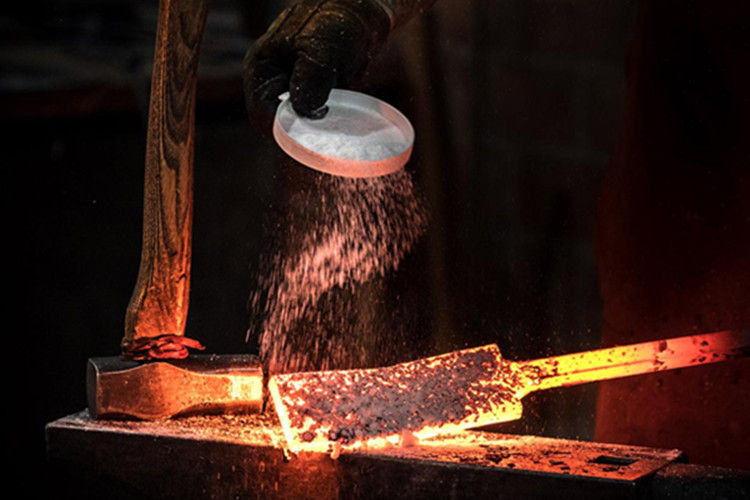
3. Enabling Successful Forge Welding
This is the most critical use of borax. When forge-welding two pieces of metal, residual oxide layers can create a barrier that hinders the formation of a strong metallurgical bond. Borax dissolves these oxides and floats them to the surface as a liquid, glass-like slag, preventing impurities and air pockets from becoming trapped in the joint. This results in a cleaner, stronger, and more reliable weld.
4. Improving Metal Flow and Bonding
By keeping the metal surface chemically clean and eliminating interfering oxide layers, borax allows the metal to flow and bond more effectively under the impact of a hammer or the pressure of a press.
Practical Tips for Blacksmiths
1. Anhydrous Borax vs. Standard Borax: Modern blacksmiths generally prefer anhydrous borax (borax with the water content removed) over standard household borax. Anhydrous borax melts faster, is less prone to sliding off the workpiece, and avoids the violent bubbling or steam explosions that can occur when the moisture in standard borax contacts hot metal.
2. Temperature Is Crucial: While borax is a highly effective flux, successful forge welding relies just as much on proper fire control and precise temperature management as it does on the flux itself. 3. Alternative Fluxes: While borax remains the traditional and most common choice, specialized commercial forge-welding fluxes are now available on the market. These products often blend borax with other compounds to achieve melting at specific temperatures or to deliver superior welding results for particular alloys, such as stainless steel or nickel.
In summary
Borax is an unsung hero in both traditional and modern forge-welding processes; acting as both a chemical protective layer and a cleaning agent, it facilitates the fusion of metal workpieces into a single, strong, and durable unit.

