- tyler@kirail.com
- +86 15603721115
Forging is one of humanity's oldest metalworking techniques. Long before the advent of modern presses and computer-controlled machinery,
early metalworkers discovered that by heating metal and striking it with a hammer, they could shape it into practical tools and weapons.
Over millennia of evolution, this simple craft has developed into the highly precise forging technology widely used today in the automotive, aerospace, energy, construction, and other industries.
1. The Origins of Forging
The earliest forms of forging date back thousands of years to ancient metalworking cultures.
Early artisans primarily worked with relatively soft metals such as copper and gold. They discovered that repeated hammering could alter a metal's shape, while heating it made the material easier to work with and reduced the risk of cracking.
The development and utilization of bronze and iron significantly elevated the importance of forging. Iron, in particular, became a crucial material for manufacturing tools, agricultural implements, weapons, and other everyday items.
The basic equipment was quite simple:
* A forge for heating the metal
* An anvil to support the workpiece
* A hammer to apply force
* Tongs and other hand tools to grip the hot metal
Modern forging processes still rely on this fundamental principle: heating or pre-treating the metal and applying controlled force to shape it into the desired form.
2. Forging in Ancient Civilizations
Ancient civilizations developed increasingly sophisticated metalworking techniques.
The Egyptians, Mesopotamians, Greeks, Romans, Chinese, and other cultural groups all utilized metal forging to create tools, weapons, ornaments, architectural components, and agricultural equipment.
China played a particularly pivotal role in the development of ironworking technology. Over time, Chinese metalworkers developed techniques that enabled the large-scale production and processing of iron and steel.
In Europe and other parts of the world, blacksmithing also emerged as a vital specialized craft. Skilled blacksmiths could produce a wide array of items, ranging from horseshoes and knives to swords, armor, agricultural tools, and various hardware components.
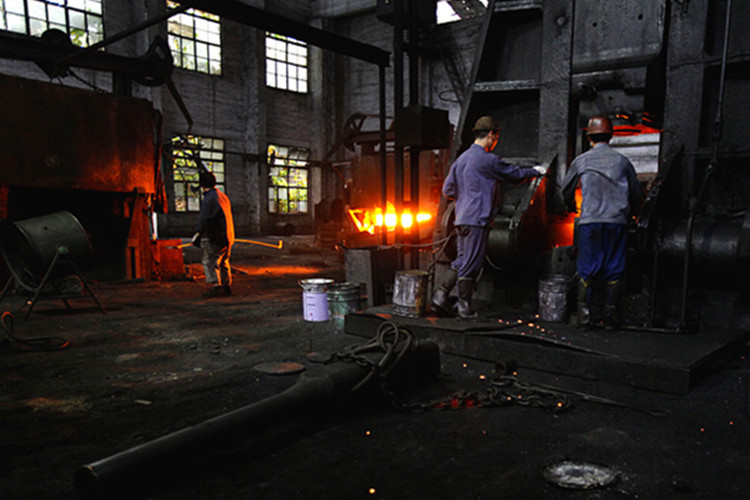
3. The Rise of the Blacksmith
In the Middle Ages, blacksmiths became indispensable craftsmen.
A typical blacksmith's workshop centered around the forge and the anvil. Blacksmiths would heat blocks of iron or steel, place them on the anvil, and strike them repeatedly with a hammer. Various forging techniques allowed them to:
* Elongate the metal
* Increase thickness
* Bend and shape the metal
* Punch holes
* Split the metal
* Join components
* Create specialized shapes
At this stage, forging relied heavily on the craftsman's skill and experience. Blacksmiths depended primarily on visual observation to gauge temperature, force, timing, and the resulting shape.
4. The Industrial Revolution Transforms Forging
The Industrial Revolution revolutionized forging processes.
As factories began producing machines, locomotives, ships, weaponry, and other large-scale products, manual forging could no longer meet the surging demand.
The advent of the mechanical forging hammer marked a significant advancement. Mechanical systems eliminated the total reliance on human muscle for swinging hammers, enabling the application of greater and more consistent striking force.
The development of the steam hammer in the 19th century was another major milestone. It allowed manufacturers to forge massive components that were beyond the capabilities of traditional blacksmiths.
This made large-scale forging a reality in industries such as:
* Railway manufacturing
* Shipbuilding
* Heavy machinery
* Military equipment
* Engine manufacturing
5. The Development of Forging Presses
Forging hammers were not the only major advancement. Forging presses became increasingly important due to their ability to apply immense pressure gradually and in a controlled manner.
Mechanical and hydraulic presses enabled manufacturers to produce large components while maintaining better control over the deformation process.
Hydraulic forging presses are particularly vital for producing ultra-large forgings, such as components for power generation equipment, aircraft, ships, and heavy industrial machinery.
6. Modern Closed-Die Forging
Another significant breakthrough was the development of closed-die forging technology.
Instead of simply hammering metal between relatively flat dies, manufacturers could design shaped cavities into the dies. When the metal billet was subjected to pressure, the metal would flow to fill these cavities. This enables the mass production of components with highly consistent shapes and dimensions.
Modern closed-die forging is widely used to manufacture components such as:
* Connecting rods
* Gears
* Crankshafts
* Steering system components
* Aircraft parts
* Automotive parts
7. Forging Enters the Aerospace Age
The 20th century brought enormous demand for strong, lightweight, reliable components.
The aerospace industry became an important driver of forging technology because aircraft and spacecraft require materials that can withstand substantial mechanical and thermal stresses.
Manufacturers developed sophisticated forging processes for materials such as:
* High-strength steels
* Aluminum alloys
* Titanium alloys
* Nickel-based superalloys
Large forging presses and precise dies enabled manufacturers to produce critical structural and engine components.
8. Computer-Controlled Forging
Modern forging differs significantly from traditional blacksmithing processes.
Computer-controlled equipment allows for the precise regulation of parameters such as:
* Forging force
* Movement of the forging hammer (or ram/slide)
* Temperature
* Die position
* Material deformation
* Production cycle time
Computer-Aided Engineering (CAE) technology also enables manufacturers to simulate metal flow within the die before the tooling is actually manufactured.
This helps identify issues such as:
* Incomplete die filling
* Excessive material flow
* Cracking
* Undercut structures
* Die wear
* Dimensional deviations
9. Advanced Forging Technologies Today
Modern forging integrates materials science, mechanical engineering, computer simulation, automation technology, and precision manufacturing processes.
Some advanced technologies include:
* Precision forging
* Isothermal forging
* Near-net-shape forging
* Roll forging
* Ring rolling
* Cold forging
* Automated hot forging
* Multi-station forging
These processes reduce the need for subsequent machining while producing components with strictly controlled mechanical properties.
10. From Blacksmith's Hammer to Smart Factory
The history of forging can be viewed as an evolution from purely manual craftsmanship to controlled industrial deformation processes:
Ancient hand hammers → Blacksmith forge forging → Mechanical hammers → Steam hammers → Forging presses → Automated forging lines → Computer-controlled smart forging
However, the fundamental principle has remained unchanged for millennia: using external force to induce plastic deformation in metal, thereby shaping it into components of practical value.
Therefore, modern forging is not a technology completely divorced from ancient blacksmithing; rather, it is the ultimate refinement of the same core concept—manufacturing robust, reliable metal components through the integrated application of thermal energy, external force, tooling, and material control.

