- tyler@kirail.com
- +86 15603721115
No, heating is not strictly required when forging steel. While heating steel until it glows red or orange—known as "hot forging"—is the most common and traditional method, steel can also be forged at or near room temperature; this process is called "cold forging."
The choice of temperature depends entirely on the desired shape, the type of steel, strength requirements, and the scale of production. Below are details regarding the three main temperature categories used in forging:
1. Hot Forging (Heating)
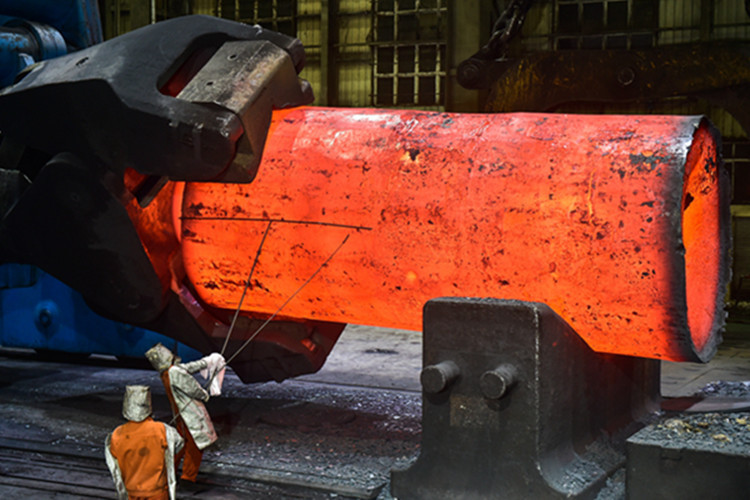
This is the traditional blacksmithing method and the most common industrial process for manufacturing large or complex parts. The steel is heated above its recrystallization temperature (typically between 1700°F and 2300°F / 900°C and 1250°C).
1) Why heat it? Heating makes the steel highly ductile (malleable) and significantly lowers its yield strength, meaning much less force is required to shape it.
2) Advantages: It enables the production of parts with highly complex shapes, massive sizes, and intricate details. Additionally, it refines the internal grain structure, eliminates voids, and improves toughness.
3) Disadvantages: It consumes energy to heat the metal; it can cause surface oxidation (scale formation), requiring subsequent cleaning; and dimensional tolerances are relatively loose due to thermal contraction as the part cools.
2. Cold Forging (No Heating/Room Temperature)
Cold forging is performed at ambient room temperature or close to it. It is a significant sector of modern industrial manufacturing.
1) How it works: Cold forging does not rely on heat to make the metal flow; instead, it uses immense mechanical pressure (from hydraulic or mechanical presses) to force the steel into a die.
2) Advantages:
* Increased strength: The process induces "strain hardening" or "work hardening," making the finished part stronger and harder than the raw material.
* High precision: It offers excellent surface finish and very tight dimensional tolerances, often eliminating the need for secondary machining.
* High efficiency: It eliminates energy waste associated with heating furnaces and allows for very high production speeds.
3) Disadvantages: It requires immense force (implying the need for heavier, more expensive machinery). The process is typically limited to simple, small-sized workpieces (such as cylinders or cones) and requires materials with high ductility (usually low- or medium-carbon steel). Additionally, it leads to increased die wear.
4) Common applications: Bolts, screws, nails, rivets, spark plug housings, and many automotive transmission components.
3. Warm Forging (Moderate Heating)
Warm forging is a process situated between cold forging and hot forging; the steel is typically heated to a moderate temperature (approximately 400°C to 1000°C / 800°F to 1800°F)—above room temperature but below the material's full recrystallization temperature.
1) Why use warm forging? It strikes a balance across several factors. Compared to cold forging, it requires less forming force; compared to hot forging, it results in less surface oxidation while achieving superior dimensional accuracy.
2) Common applications: Automotive gears, shafts, connecting rods, and other components where a balance of strength, precision, and cost is required.
Summary: Is heating necessary
1) If you are a traditional blacksmith using an anvil and hammer, the answer is yes: you almost always need to heat the steel. Attempting to significantly alter the shape of steel at room temperature using a hand hammer is likely to damage your tools, cause personal injury, or crack the metal.
2) If you are involved in industrial manufacturing, the answer is no: heating is not strictly necessary. For the mass production of small, relatively simple, high-strength parts—such as fasteners—cold forging is often the superior, more efficient method, and it can actually impart greater strength to the workpiece.

