- tyler@kirail.com
- +86 15603721115
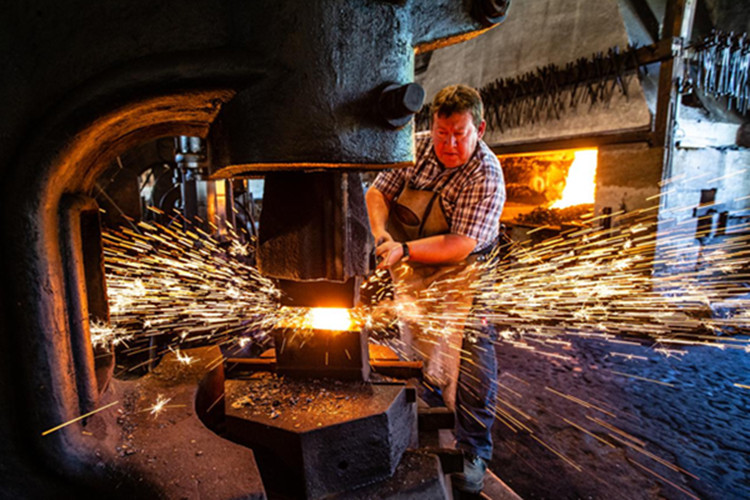
A forging hammer is a powerful piece of equipment used to shape metal through rapid, high-energy impacts. Unlike forging presses, which apply slow, sustained pressure, forging hammers rely on kinetic energy to deform the metal almost instantaneously.
Below is a detailed breakdown of the working principles, key components, and common industrial types of forging hammers.
1. Core Working Principle
The fundamental principle of a forging hammer is the conversion of stored or generated energy (potential, pneumatic, or hydraulic energy) into kinetic energy. When the machine's heavy upper assembly (the ram or tup) strikes the heated metal, kinetic energy is transferred to the workpiece, causing rapid plastic deformation and metal flow that conforms to the shape of the die cavity.
2. Key Components of a Forging Hammer
1) Ram (or Tup): The heavy, moving component that carries the upper forging die. Its mass and velocity determine the magnitude of the impact force.
2) Anvil: A massive, stationary base (often weighing several times more than the ram) that supports the lower die and absorbs immense impact forces while remaining stable.
3) Dies: Hardened steel tools mounted on the ram and anvil. In closed-die forging, the dies feature the contoured shape of the target part (female mold).
4) Drive Mechanism: The system responsible for lifting the ram and accelerating it downward. This mechanism varies depending on the type of forging hammer (gravity-drop, pneumatic, or hydraulic).
3. Forging Process Steps
1) Heating: The metal billet is heated in a furnace to a specific temperature (usually red-hot or orange-hot) to increase its ductility.
2) Positioning: The heated billet is placed onto the lower die, which is secured to the anvil.
3) Lifting: The drive mechanism raises the ram to a predetermined height or pressure state.
4) Striking: The ram is released or driven downward, striking the metal with tremendous force. The metal flows outward to fill the die cavity.
5) Repetition: The operator (or an automated system) quickly repositions the metal and delivers successive blows until the workpiece reaches its final shape and dimensions.
4. Types of Forging Hammers
The method used to lift and drive the downward stroke of the hammer head (ram) determines the type of forging hammer:
1) Gravity Drop Hammer: The simplest type. A mechanical system (such as friction rollers or a lifting board) raises the hammer head to a set height and then releases it, allowing it to fall solely under the force of gravity. Impact energy depends entirely on the weight of the hammer head and the height of the drop.
2) Pneumatic (Air) or Steam-Powered Hammers: These machines use compressed air or steam to actively accelerate the hammer head downward, generating an impact force far greater than that of gravity alone. A compression cylinder generates pressure, and the gas is then directed into the working cylinder to drive the ram downward at extremely high speed and force. This results in blows that are faster, more powerful, and easier to control.
3) Hydraulic Forging Hammers: A modern hybrid machine that utilizes hydraulic energy storage and gas expansion to lift and drive the hammer head. Hydraulic hammers offer excellent control over impact energy and high efficiency, as the force of each blow can be programmed and adjusted.
5. Why use a forging hammer instead of a press?
1) Speed and Efficiency: Forging hammers can deliver dozens of blows per minute, offering extremely high production efficiency for parts with specific geometries.
2) Grain Refinement: The rapid, high-impact deformation process breaks down coarse grain structures in the metal, resulting in a finer, tougher, and more uniform internal microstructure.
3) Deep Penetration: The shock waves generated by the hammer's impact penetrate deep into the workpiece core, ensuring that even the center of thick billets is thoroughly forged and densified, thereby eliminating internal voids or porosity.
In summary
Forging hammers operate by using controlled, high-speed impacts to force heated metal into the desired shape. From the simple gravity drop hammers of the early Industrial Revolution to today's computer-controlled pneumatic and hydraulic models, the core mechanical principle remains a brilliant application of physics in the field of metalworking.

