- tyler@kirail.com
- +86 15603721115
Steel forging enhances strength through metallurgical and mechanical changes that occur when the metal is subjected to immense compressive forces. Unlike casting (pouring molten metal) or machining (cutting away material), forging actively improves the internal structure of the steel.
Here are four key mechanisms by which forging increases steel strength:
1. Grain Flow Alignment (The "Wood Grain" Effect)
All metals possess a crystalline microstructure composed of "grains."
1) In cast steel: Grains are randomly distributed upon cooling, creating a chaotic, isotropic structure with no specific direction of strength.
2) In forged steel: During forging, the metal undergoes massive deformation and flow, causing the grains to stretch and align precisely with the contours of the part.
Analogy: Consider wood. Wood is extremely strong when force is applied along the grain, but it splits easily if force is applied perpendicular to the grain. Forging aligns the steel's "grain" flow with the shape of the component (such as a crankshaft or wrench), ensuring that maximum strength is concentrated where the part experiences the greatest stress.
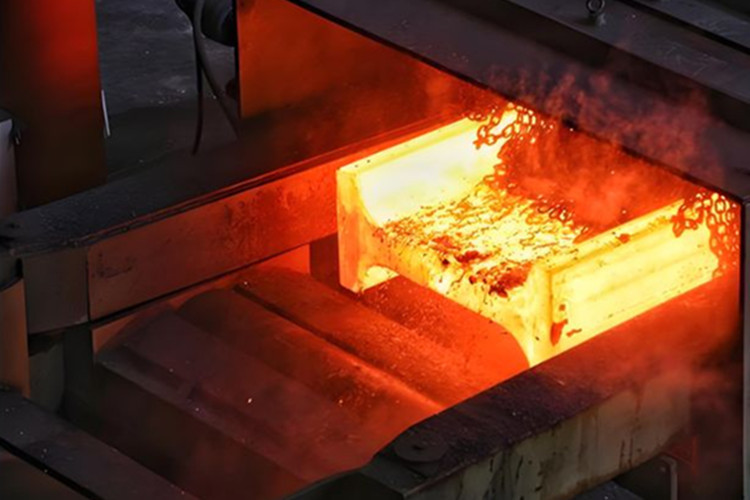
2. Elimination of Internal Defects
Metals shrink as they cool during casting, often resulting in tiny internal voids, gas pockets, and shrinkage cavities (porosity). These defects can act as stress concentration points, making the metal prone to cracking under load.
1) The forging solution: The immense compressive forces applied during forging squeeze these internal voids shut. Under the combined action of high heat and pressure, the inner surfaces of these closed voids undergo metallurgical bonding (welding). The result is a high-density, uniform material virtually free of internal weak points.
3. Grain Refinement (Hot Forging)
During hot forging, the steel is heated above its "recrystallization temperature." As the metal deforms, the original grains—which are often coarse and weaker—are broken down.
1) Upon cooling, the metal undergoes recrystallization, forming a new structure composed of smaller, finer, and more uniform grains.
2) In metallurgy, smaller grain size implies a greater number of "grain boundaries." These boundaries act like roadblocks, impeding the movement of dislocations (lattice defects that allow the metal to deform). The more "obstacles" present, the harder, tougher, and more crack-resistant the metal becomes (a principle known as the Hall-Petch relationship).
4. Work Hardening / Strain Hardening (Cold Forging and Warm Forging)
When steel is forged at or near room temperature (i.e., cold forging), the phenomenon of "work hardening" occurs.
1) As the metal undergoes plastic deformation, trillions of microscopic defects—known as "dislocations"—are generated within its crystal lattice.
2) These dislocations multiply and become entangled with one another, effectively "jamming" the internal structure. This makes further deformation increasingly difficult, thereby significantly increasing the material's yield strength and hardness without the need for additional heat treatment.
Forging, Machining, and Casting: A Brief Comparison
Process | Effect on Metal Structure | Resulting Strength |
Casting | Random grain structure; prone to internal porosity and shrinkage voids. | Lowest strength; brittle; prone to sudden failure under shock loads. |
Machining | Cuts through the natural grain of the raw material (bar stock or forging), exposing the ends of the grains at the surface. | Moderate strength; creates stress risers and weak points where cracks can initiate. |
Forging | Aligns the grain flow to the part's shape, closes internal voids, and refines the grain structure. | Highest strength, superior fatigue resistance, and excellent impact toughness. |
Summary
Forging is not merely a method for shaping steel; it also optimizes the material's structure at the microscopic level. By aligning grain flow, eliminating internal defects, refining the crystal structure, and—in the case of cold forging—inducing work hardening, the forging process produces components that far outperform those made by other manufacturing methods in terms of withstanding extreme stress, impact, and fatigue loads. For this reason, critical components with stringent safety requirements—such as aircraft landing gear, engine crankshafts, and heavy-duty tools—are almost invariably manufactured using forging processes.

