- tyler@kirail.com
- +86 15603721115
The key to choosing the right advanced forging heating equipment lies in accurately matching the workpiece specifications, material properties, and production cycle requirements. Medium-frequency induction heating furnaces are the preferred mainstream choice due to their significant advantages such as fast heating speed, precise temperature control, energy saving, and easy automation integration. For precision forging or scenarios with high environmental requirements, digital induction heating equipment equipped with a closed-loop temperature control and intelligent management system can be further selected.
1. Selecting the Type of Forging Heating Equipment Based on Workpiece Specifications
1) Small-sized bar stock (diameter < 20mm): Suitable for high-frequency induction heating furnaces, with frequencies reaching over 100kHz, achieving rapid local or overall heating, with temperature rise taking only a few seconds. Suitable for continuous production of large batches of bolts and pins.
* Advantages: High heating efficiency, unit energy consumption approximately 0.6–0.7 kW·h/kg
* Note: Poor inductor versatility; coils need to be customized for different specifications.
2) Medium-sized round steel/bar stock (diameter 20–150mm): Medium-frequency induction heating furnace (1–20kHz) is recommended. It is the mainstream configuration in the current forging industry and is widely used for through-heating treatment of automotive and aerospace parts such as gears, connecting rods, and crankshafts.
* Uniform heating, small core-to-surface temperature difference, forging surface roughness <50μm
* Material savings of 20–50kg per ton, material utilization rate up to 95%
* Can be linked with robotic arms for fully automated loading and unloading.
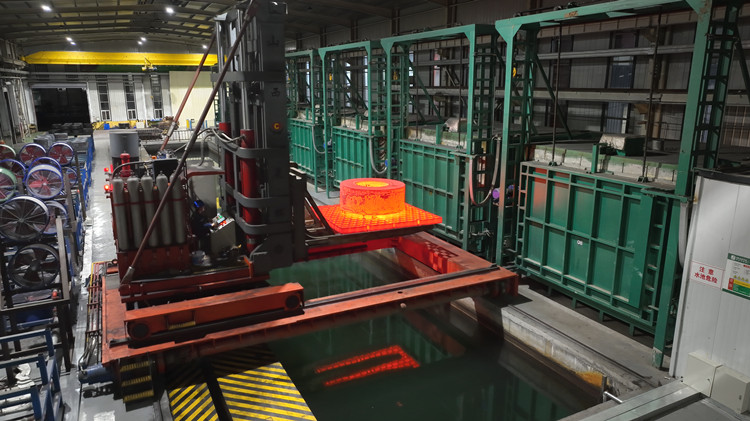
3) Large-sized or heavy-duty forgings (diameter >150mm or large single-piece weight): Industrial frequency induction heating equipment or trolley-type electric heating furnaces are optional, especially suitable for the slow and uniform heating of large steel ingots and shaft parts.
* Industrial frequency heating (50Hz) offers deep penetration, suitable for large cross-section workpieces.
* Trolley-type furnace with a loading capacity of 5–200 tons, operating temperature of 1300℃, and temperature control accuracy of ±1℃, suitable for single-piece or small-batch production.
2. Matching the automation level of forging heating equipment according to production capacity requirements:
* Production Capacity Level | Recommended Configuration | Features
1) Small Batch / Multiple Varieties: Single machine + manual loading and unloading. Flexible operation, low investment, suitable for non-standard parts trial production.
2) Medium Batch / Stable Orders: Semi-automatic line (elevator + induction furnace). Reduces manual intervention and improves cycle time consistency.
3) Large Batch / Continuous Production: Fully automatic induction heating production line. Integrates loading, heating, sorting, and descaling, achieving unmanned operation.
* Tip: For scenarios with an annual production capacity of millions of pieces or more, it is recommended to choose an intelligent system with PLC control and a process database, supporting parameter calling, quality traceability, and remote operation and maintenance.
3. Optimize Selection Based on Material and Process Requirements
1) Carbon Steel and Alloy Steel: Conventional medium-frequency heating is sufficient, with temperature control between 800–1200℃.
2) Stainless Steel and High-Temperature Alloys: Multi-stage heating is recommended, with medium-temperature preheating followed by high-temperature through-heating to prevent grain coarsening.
3) Aluminum Alloys: A dedicated aluminum alloy forging furnace is required, with a maximum operating temperature of 600℃. Hot air circulation should be used to ensure uniform temperature.
4) Precision Forging: Low-oxidation or non-oxidation heating methods must be selected, such as controlled atmosphere furnaces or medium-frequency induction heating, to avoid decarburization affecting surface hardness.
4. Comprehensive Selection Recommendation Process
1) Clarify Heating Purpose: Overall through-heating? Localized heating? Is online integration required? 2) Determine workpiece parameters: material, diameter, length, and unit weight.
3) Assess production requirements: shift/annual output, production cycle time.
4) Select heating method: choose frequency based on size (high frequency/medium frequency/power frequency).
5) Match automation level: manual → semi-automatic → fully automatic.
6) Examine supporting systems: cooling circulation, dust removal, temperature control accuracy, and energy consumption.

