- tyler@kirail.com
- +86 15603721115
Forging heat treatment is a key process for improving the strength, hardness, and long-term performance of forgings. Forging determines the shape and grain orientation of the forging, while heat treatment refines its internal structure through controlled heating and cooling cycles.
At Kingrail Parts, we integrate forging, CNC machining, heat treatment, and inspection into a single controlled process. This ensures consistent product performance in terms of hardness, dimensional stability, and mechanical properties, meeting the demands of demanding industrial applications such as mining equipment, construction machinery, and energy systems.
1. What is Forging Heat Treatment?
Forging heat treatment refers to the controlled heat treatment of forged steel parts to alter their microstructure and mechanical properties. By adjusting the temperature, holding time, and cooling method, manufacturers can optimize the hardness, toughness, wear resistance, and fatigue strength of the parts.
This process is widely used for critical forged components such as shafts, gears, rings, and hydraulic components, whose performance under load is crucial.
2. Why Heat Treatment is Crucial for Forged Parts
Heat treatment plays a key role in improving the performance of forgings:
1) Enhances fatigue resistance under cyclic loading
2) Refines grain structure, increasing strength
3) Eliminates internal stress after forging
4) Improves wear and corrosion resistance
5) Ensures dimensional stability during machining
Without proper heat treatment, forged parts may fail prematurely, crack, or deform during use.
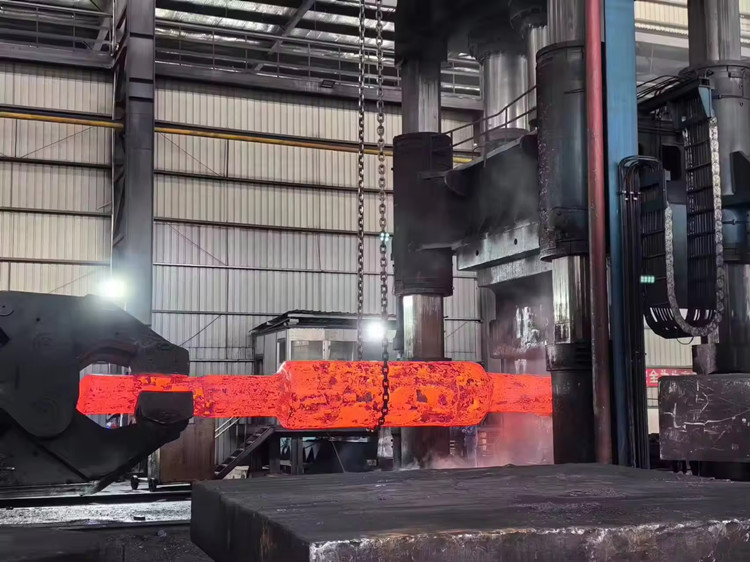
3. Heat Treatment Process
1) A typical process flow includes:
Forging → Controlled Cooling → Heat Treatment → CNC Machining → Inspection
During heat treatment, forged steel parts are heated to a specific temperature range, held for a specified time, and then cooled under controlled conditions.
2) Key control factors include:
* Heating temperature (e.g., 800–950°C depending on the material)
* Holding time
* Cooling method (air, oil, water)
* Furnace uniformity
Precise control ensures consistent mechanical properties for each batch of products.
4. Main Heat Treatment Methods for Forged Steel
1) Annealing
* Reduces hardness, eliminates internal stress, and improves machinability.
* Typical application: Pre-machining of large forgings.
2) Quenching
* Rapid cooling increases hardness and strength.
* Typical application: Wear-resistant parts such as gears and shafts.
3) Tempering
* Reduces brittleness after quenching and improves toughness.
* Typical application: Structural forgings subjected to dynamic loads.
4) Normalization
* Refines grain structure and improves uniformity.
* Typical application: General-purpose forged steel parts.
5. Heat Treatment Quality Control and Testing
At Kingrail Parts, heat-treated forgings undergo rigorous inspection to ensure their performance:
1) Hardness testing (HB/HRC)
2) Ultrasonic testing (UT) for detecting internal defects
3) Magnetic particle testing (MT) for detecting surface cracks
4) Microstructure analysis
5) Dimensional inspection after heat treatment
This integrated quality control ensures reliability and batch consistency.
6. Common Heat Treatment Defects and Their Avoidance Methods
1) Improper heat treatment can lead to:
* Cracks caused by rapid cooling
* Distortion caused by uneven temperature distribution
* Insufficient hardness
* Residual stress
2) At Kingrail Parts, we minimize these risks by:
* Controlled furnace parameters
* Standardized process routes
* Real-time temperature monitoring
* Experienced engineering control
7. Applications of Heat-Treated Forgings
Heat-treated forgings are widely used in:
1) Mining equipment (wear-resistant parts)
2) Engineering machinery (structural strength)
3) Energy systems (thermal stability)
4) Hydraulic systems (pressure resistance)
5) Gears and transmission systems
Each application requires appropriate heat treatment to ensure precise mechanical properties.
8. Forging Heat Treatment Costs and Delivery Time
1) Heat treatment costs depend on:
* Material type
* Part size and complexity
* Heat treatment method
* Batch size
2) Typical delivery time:
* Sample + Validation: 5-7 days
* Batch production (including machining): 20-30 days
* Integrated manufacturing helps shorten overall production cycles and reduce costs.
Why Choose Kingrail Parts
We offer fully integrated manufacturing solutions:
1) Forging + CNC Machining + Heat Treatment + Inspection
2) ERP-based production tracking
3) 100% material traceability
4) Ultrasonic and magnetic particle testing capabilities
5) Consistent batch consistency
This ensures that every component meets global standards such as ASTM, EN/DIN, ISO, and GB.
Conclusion
From forging processes to forging heat treatment, Kingrail Parts provides fully integrated manufacturing solutions for high-performance forged steel components. By combining advanced forging technology, precision CNC machining, and controlled heat treatment, we ensure that every part possesses superior strength, dimensional accuracy, and long-term reliability.
Frequently Asked Questions
1) What is heat treatment for forgings?
Heat treatment for forgings is a process that improves the mechanical properties of forged steel by controlling the heating and cooling of the forged material. It improves strength, hardness, wear resistance, and fatigue life by refining the material's microstructure without altering its shape.
2) What are the main types of heat treatment for forgings?
The main types of heat treatment for forgings include annealing, quenching, tempering, and normalizing. Each process alters the material's microstructure to achieve specific properties, such as improved machinability, increased hardness, improved toughness, or a more uniform grain structure.
3) Why is heat treatment important for forged parts?
Heat treatment is crucial for forged parts because it increases strength, eliminates internal stress, and enhances fatigue resistance. It ensures that parts can withstand heavy loads, reduce deformation during machining, and maintain stable performance in harsh industrial applications.
4) What are the heat treatment temperatures used for forged steel?
The heat treatment temperature for forged steel is typically between 800°C and 950°C, depending on the material and process type. Precise temperature control is crucial for achieving consistent hardness, avoiding defects, and ensuring reliable mechanical properties.

