- tyler@kirail.com
- +86 15603721115
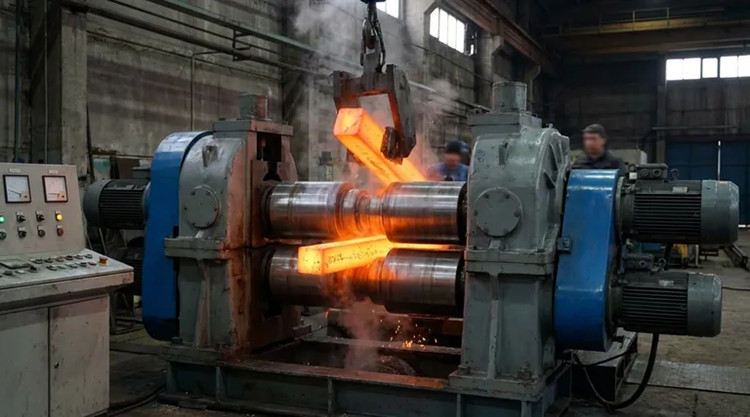
Although both roll forging and rolling are metalworking processes that use rotating rollers to form metal, their applications, principles, and forming results differ. Here are the main differences:
1. Definition and Basic Principles
1) Rolling: This is a primary metal forming process that reduces the thickness of a metal billet, achieves uniform thickness, or imparts desired mechanical properties to the material by passing it through one or more pairs of rotating rollers.
2) Roll Forging: This is a specialized forming process (classified under forging) used to reduce the cross-sectional area of a heated cylindrical or rectangular billet; the process utilizes a set of relatively rotating rollers with grooves etched to match the desired part shape. It effectively combines the characteristics of rolling and die forging.
2. Main Applications
1) Rolling: Primarily used for the large-scale production of basic metal raw materials or semi-finished products, such as thin plates, thick plates, strips, pipes, and standard structural profiles (such as I-beams).
2) Roll Forging: Primarily used for manufacturing high-strength, high-quality mechanical parts, such as crankshafts, connecting rods, steering knuckles, and axles. It is often used as a pre-forming process to optimize material distribution before final closed-die forging.
3. Tooling and Deformation Mechanism
1) Rolling: The rollers used typically have smooth surfaces or simple continuous profiles, applying uniform compressive force to stretch and compress the material uniformly along its width or thickness.
2) Roll Forging: The rollers have specific local grooves or die features. This process involves complex three-dimensional deformation, with the material undergoing directional displacement along the length of the billet, thereby increasing or decreasing the cross-sectional area of specific locations as needed.
4. Material Properties and Grain Structure
1) Rolling: While this process improves overall mechanical properties and refines the grain structure, the resulting grain flow is generally linear and uniformly distributed throughout the product.
2) Roll Forging: Parts produced by this process have excellent material density and form an optimized, continuous grain flow that perfectly matches the part's profile. This results in roll forgings exhibiting significantly superior strength and fatigue resistance compared to conventionally rolled or machined parts.
5. Production Costs and Efficiency
1) Rolling: Characterized by its simple process, high production efficiency, and relatively low cost, roll forging is ideal for continuous processing of large quantities of material.
2) Roll Forging: This process requires precise control, accurate die design, and temperature management, and typically involves multiple forming passes, thus exceeding the cost and technical requirements of conventional rolling. However, compared to traditional closed-die forging, it still offers greater flexibility and lower tooling costs.
Summary
In short, rolling is a continuous process geared towards large-scale production, designed to efficiently and cost-effectively manufacture uniform basic metal shapes (such as plates or bars). Roll forging, on the other hand, is a more specialized multi-pass process designed to shape heated billets into complex, high-strength parts with optimized internal grain structures, thus bridging the gap between raw material production and precision forging.

