- tyler@kirail.com
- +86 15603721115
1. What is forging?
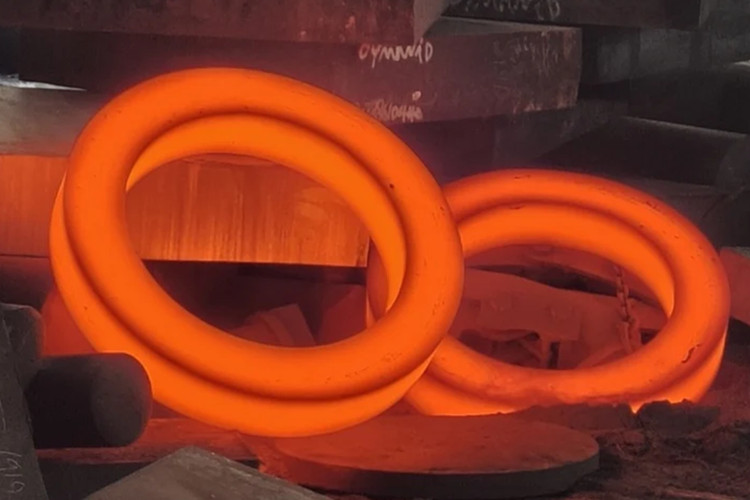
Forging is a manufacturing process that presses, hammers, or extrudes metal under high pressure into a high-strength part, called a forging. This process typically involves preheating the metal to a specific temperature, generally about 75% of its melting point. It's important to note that forging is distinct from casting because the metal used to make forgings is not melted and poured like in a foundry (a factory that produces metal castings).
Forged parts are stronger than those produced by any other metalworking process. Forging utilizes the natural grain flow of the metal, aligning the grain flow with the unique geometry of each part. This grain flow profile disappears during machining, as does the case with cast parts. Compared to welded parts, forgings are formed as a single piece because weld quality is difficult to guarantee without additional inspection.
Closed-die forging uses custom-made dies or presses. These dies ensure excellent consistency and repeatability of the final product because the forging process can be repeated on each part. This ensures consistency in size and quality across the entire batch of products. Subsequent processing, such as heat treatment, can impart similar physical properties to the entire batch.
Forgings can be made into almost any shape, reducing the need to join multiple parts. Since forgings do not require welding or other methods to hold them together, fewer connection points increase overall strength.
Heat-treated forgings are almost immediately usable after cooling, inspection, and cleaning, but many forgings are subsequently cut and/or machined. Forging surfaces are suitable for electroplating, polishing, painting, or other protective coatings.
2. What are the differences between forgings and castings?
Forgings are stronger. Castings do not offer the strength gains associated with hot and cold forging. Forging is superior to casting in terms of the predictability of strength properties and can produce high-quality parts with better ductility and higher strength, while ensuring consistent quality throughout the production process.
Forging can refine defects in ingots or continuously cast bars. Castings lack grain flow and directional strength, and the casting process cannot prevent the formation of certain metallurgical defects. Pre-processing forgings can create grain flow oriented along the direction of strength requirements. Forging can also refine dendrite structures, alloy segregation, and similar defects.
Compared to castings, forgings are more reliable and generally have lower long-term costs. Casting defects take many forms. Because hot working refines the grain structure and imparts high strength, ductility, and wear resistance to each forging, they are also more durable. Furthermore, forging production does not require the same stringent process control and inspection as casting, saving additional costs.
Forgings also respond better to heat treatment. Castings require strict control of the melting and cooling process because alloy segregation can occur. This can lead to uneven heat treatment response, affecting the straightness of the finished part. Forgings have a more predictable response to heat treatment and better dimensional stability.
Forging production is flexible and inexpensive, making it easier to adapt to market demands. Some castings, such as special performance castings, require expensive materials and stringent process control, and have longer lead times. Open die forging and ring rolling forging processes can accommodate different production batches and shorten delivery cycles.
3. How do forgings differ from welded/structural parts?
Forging offers advantages in production economy and material savings. Welded structures are more expensive in mass production. In fact, as production volume increases, welded parts are often converted to forgings. The initial die cost of forging can be offset by increased production volume and material savings. The production economy of forging is reflected in reduced labor costs, reduced scrap and rework, and lower inspection costs.
Forgings are stronger. Welded structures often have porosity. Any strength advantage gained from welding or fastening standard rolled products can be lost due to poor welding or joining processes. The grain orientation formed during forging can improve the strength of the part.
Forgings also have the advantage of high cost-effectiveness. The cost advantage of multi-part welded assemblies is far less than that of well-designed integral forgings. This component integration can significantly reduce costs. Furthermore, welded parts require expensive inspection procedures, especially for high-stress components. Forgings do not require these procedures.
Forgings offer more stable and superior metallurgical properties. Selective heating and uneven cooling during welding can lead to undesirable metallurgical properties such as inconsistent grain structure. Welded seams can develop notches during use, causing part failure. Forgings, lacking internal voids, are less prone to accidental failure under stress or impact.
Forging simplifies the production process. Welding and mechanical fastening require careful selection of connection materials, fastener types and sizes, and rigorous monitoring of the fastening process, all of which increase production costs. Forging simplifies the production process and ensures higher quality and consistency.
4. How do forgings differ from machined bars/plates?
Forgings offer a wider range of required material grades and sizes. The size and shape of products made from steel bars and plates are limited by the available dimensions of the raw materials. Often, for certain grades of material, forging may be the only metalworking process capable of producing the required dimensions. Forgings can cost-effectively produce parts of various sizes, from parts smaller than 1 inch in size to parts weighing over 450,000 pounds.
Forgings achieve higher strength because their grain orientation aligns with their shape. Machined bars and plates are more susceptible to fatigue and stress corrosion because machining disrupts the material's grain structure. In most cases, forging creates a grain structure aligned with the part's external contour, resulting in optimal strength, ductility, impact resistance, and fatigue resistance.
Forging processes utilize material more efficiently and economically. Flame cutting of sheet metal is a wasteful process, one of many steps in manufacturing that consumes far more material than is needed to produce parts such as rings or hubs. Subsequent machining further increases material loss.
Forgings produce less scrap and are more productive. Forgings, especially near-net-shape parts, utilize material better and generate less scrap. Forgings offer significant cost advantages in mass production.
Forgings require fewer secondary machining steps. Certain grades of bars and plates require additional machining at the factory, such as turning, grinding, and polishing, to remove surface defects and achieve the desired surface finish, dimensional accuracy, machinability, and strength. Forgings can usually be put into use without expensive secondary processing.

