- tyler@kirail.com
- +86 15603721115
Forging or Machining: Which Manufacturing Process is Best for Your Application? For buyers, choosing the wrong process can lead to costly mistakes, such as increased waste, decreased product performance, or even material failure under real-world usage conditions. Forging and machining each have their unique advantages and limitations, so understanding their technical differences is crucial before deciding which process best suits your needs.
This article will delve into forging and machining, analyzing their key differences, material considerations, applications across industries, and specific technical details. We will also explore the technical details and how each process affects performance, precision, and cost-effectiveness.
1. What is Forging?
Forging is one of the oldest metalworking processes, dating back thousands of years, and remains one of the most efficient methods for producing strong and durable parts. The process uses methods such as hammering, pressing, or rolling to apply localized compressive force to shape metal. Typically, the metal is heated to a ductile state (hot forging). Of course, metal can also be formed at room temperature (cold forging) or at medium temperatures (warm forging).
2. Forging Process Types
1) Hot Forging – Performed at temperatures above the metal's recrystallization temperature (over 1000°C for steel), hot forging reduces yield strength and increases flexibility, allowing for the forging of complex shapes without cracking. It enhances mechanical properties by refining the grain structure and eliminating defects.
2) Cold Forging – Performed at or near room temperature, cold forging is ideal for softer metals such as aluminum. It produces high-strength parts through strain hardening, offering excellent surface finish and dimensional accuracy, but with limited shape complexity.
3) Warm Forging – Warm forging occurs at temperatures between 600°C and 800°C, combining the advantages of hot and cold forging. It improves material flow control, increases precision and surface finish, while maintaining a certain level of strength.
1. What is Machining?
Unlike forging, machining is a subtractive manufacturing process. Machining creates the final part by removing excess material from the workpiece. This is typically accomplished using high-precision, highly automated numerical control (CNC) machine tools.
2. Machining Process Types
1) Material Machining – This involves removing material from a stationary workpiece using a rotating cutting tool. CNC milling can handle complex geometries and is widely used in the production of complex 3D parts. The flexibility of CNC milling allows it to manufacture simple and complex parts with tight tolerances.
2) CNC Turning – In this process, the workpiece rotates while a fixed cutting tool shapes it. CNC turning is typically used to machine cylindrical parts, achieving extremely high precision and surface finish.
3) Drilling – A rotating cutting tool drills holes in the workpiece. Drilling is one of the fundamental machining processes and can be applied to a variety of materials, including metals and plastics.
4) Grinding – Grinding uses a grinding wheel to achieve ultra-smooth surface finishes and extremely high dimensional accuracy, especially suitable for hardened materials. It is often used as a finishing process after milling or turning.
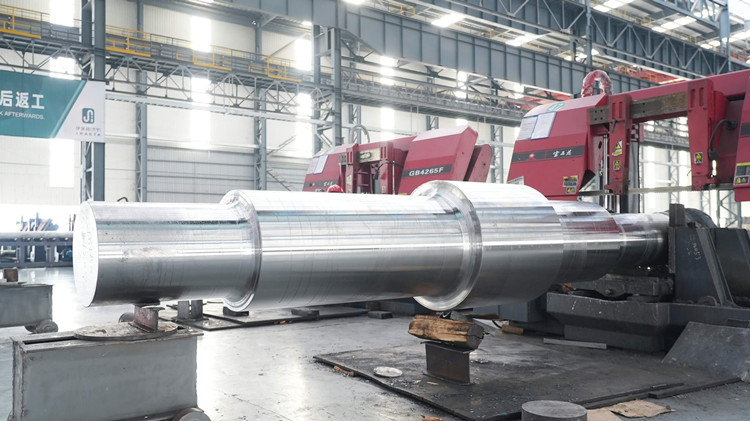
3. Material Considerations for Forging and Machining
Forging and machining can both process a wide variety of materials, but each process has its limitations and advantages.
1) Materials Used in Forging
Forging is best suited for metals with good plasticity at high temperatures, including:
* Steel and alloy steels—These materials are often forged due to their strength and hardness. Forged steel typically has higher yield strength and tensile strength than cast or machined steel. For example, forging can increase the strength of medium carbon steel by up to 30%.
* Aluminum—Aluminum is often forged into lightweight components for industries such as automotive and aerospace. Forging aluminum can improve its mechanical properties while maintaining its lightweight characteristics.
* Titanium—Titanium's high strength-to-weight ratio and excellent corrosion resistance make it an ideal material for forging, especially for high-performance aerospace components.
2) Materials Used in Machining
Machining can be applied to a variety of materials, including:
* Aluminum alloys—Aluminum alloys are among the most commonly used materials in machining due to their softness and ease of processing. They are widely used in industries such as electronics and automotive.
* Stainless steel—Renowned for its corrosion resistance and strength, stainless steel is often machined into precision parts for medical, automotive, and aerospace applications. * Plastics and Composites – Unlike forging, machining is also suitable for non-metallic materials such as plastics and composites, making its applications very wide-ranging. Industries such as medical devices and electronics often rely on machined plastic parts to achieve lightweight and non-conductive properties.
4. Strength and Durability – Forging vs. Machining
In terms of mechanical strength, forging is consistently superior to machining, especially for parts subjected to high stress and fatigue over long periods.
1) Forging Strength Forged parts have higher structural strength due to their well-aligned grains that fit tightly to the part's contours. This grain alignment improves the mechanical properties of the metal, thereby increasing impact resistance and fatigue life. For example, forged crankshafts in internal combustion engines can withstand higher cyclic loads than machined crankshafts.
2) Strength of Machined Parts Machined parts generally have lower mechanical strength because machining disrupts the material's natural grain structure. However, this increase in strength is reflected in the precision and complexity of the parts. Machined parts are often used in applications requiring extremely high dimensional accuracy but not high mechanical strength, such as small electronic housings or prototype parts.
5. Tolerances and Precision – Forging vs. Machining
In terms of tolerances, machining is far superior to forging.
1) Machining Tolerances
Machining can achieve extremely high precision – typically within the micrometer range. This precision is crucial for industries with extremely high dimensional requirements, such as aerospace, electronics, and medical devices. CNC machine tools can achieve precision down to ±0.001 mm, making machining the preferred process for precision parts.
2) Forging Tolerances
Due to the nature of the forging process, the dimensional tolerances of forgings are typically large. While the dimensional accuracy of forgings is acceptable for most heavy-duty applications, secondary machining, such as forging, may be necessary to achieve higher precision. This is common in industries requiring both strength and precision, such as the automotive or aerospace industries. For example, forged automotive parts may require finishing to meet the required dimensional specifications.
6. Surface Finish – Forging vs. Machining
Surface finish plays a crucial role in the performance of parts, especially in applications involving wear, lubrication, or aesthetics.
1) Forging Surface Finish
Due to the nature of the forging process, forgings typically have a rougher surface finish, with surface roughness values (Ra) usually ranging from 3.2 to 25 micrometers. This may be acceptable in industries such as construction or heavy machinery, but for more demanding applications, additional finishing processes such as grinding or polishing are required.
2) Machining Surface Finish
Machined parts can achieve extremely smooth surface finishes. Depending on the tool, feed rate, and cutting speed, surface roughness values can be as low as 0.4 micrometers. This makes machining ideal for manufacturing parts requiring low coefficients of friction, high aesthetic requirements, or high precision fits.
7. Cost-Effectiveness – Forging vs. Machining
Cost is often a decisive factor when choosing between forging and machining.
1) Forging Costs
For mass production of simple to moderately complex parts, forging is generally more cost-effective. While initial die costs (dials, presses) are higher, once set up, the cost per part decreases significantly as production volume increases. Compared to machining, forging results in minimal material waste, further reducing costs.
2) Machining Costs
Machining is typically more expensive due to its longer processing time and higher material loss. Complex parts often require multiple machining operations using different tools, increasing cycle time. Furthermore, material removal generates scrap, increasing material costs, especially for expensive metals like titanium or nickel alloys.
* Aspects of Forging vs. Machining
1) Process: Forming using compressive force; Subtractive manufacturing (material removal)
2) Strength: Higher mechanical strength; Lower mechanical strength
3) Tolerance: Medium tolerance; Tight tolerance (micrometer level)
4) Surface Finish: Rough surface finish; Smooth surface finish
5) Material Waste: Low waste; Higher material waste
6) Material Options: Metals such as steel, aluminum, and titanium; Metals, plastics, and composites
7) Production Volume: Best suited for high-volume production; Suitable for low-volume production or prototyping
8) Cost-Effectiveness: Economical for high-volume production; Economical for low-volume production or prototyping
Conclusion
The choice between forging and machining depends on your specific application requirements, such as strength, precision, surface finish, and cost. Forging is well-suited for producing high-strength, durable parts with good grain flow, making it suitable for the automotive, aerospace, and heavy machinery industries. Machining, on the other hand, excels at producing parts with tight tolerances, complex geometries, and high surface finishes, making it the preferred process for precision engineering applications.

