- tyler@kirail.com
- +86 15603721115
This article provides a comprehensive analysis of forging technology for stainless steel, covering material properties, process parameters, challenges, equipment, and future development trends.
1. Introduction
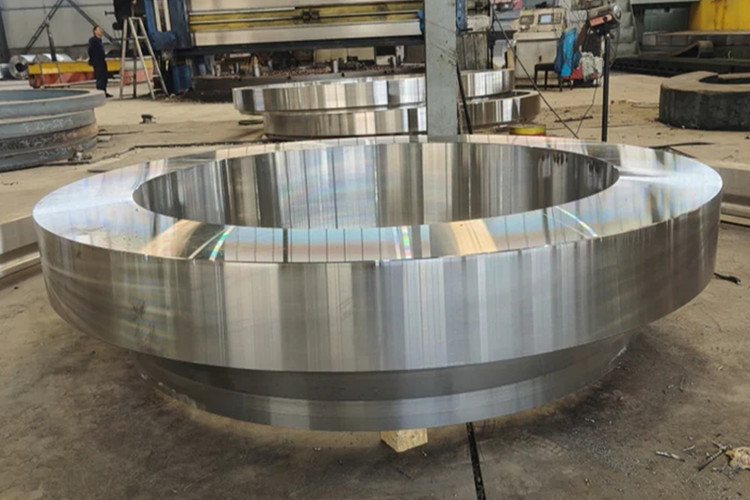
Forging is a manufacturing process that uses localized compressive force to shape metal. Forging is particularly important for stainless steel because it refines the grain structure, eliminates internal voids, and creates a continuous grain flow, resulting in superior mechanical properties (toughness, fatigue resistance) compared to casting or machining, while maintaining the alloy's inherent corrosion resistance.
2. Forging Characteristics of Different Types of Stainless Steel
Stainless steel is not a single material; its metallurgical structure determines its forging characteristics.
1) Austenitic Stainless Steel (e.g., 304, 316, 321):
* Characteristics: High ductility at high temperatures, but severe work hardening. Low thermal conductivity, leading to uneven heating/cooling.
* Forging Precautions: Strict temperature control is required. Forging Range: The forging range is relatively wide, but the final forging temperature must be high enough to prevent overwork hardening and cracking.
2) Martensite (e.g., 410, 420, 440°C):
* Properties: Hardenable through heat treatment. Low ductility at room temperature; prone to thermal shock and forging cracks if cooled too quickly.
* Forging Precautions: Preheating of the billet and die is required. Post-forging cooling must be strictly controlled (usually furnace cooling) to prevent martensitic transformation and cracking before annealing.
3) Ferrite (e.g., 430, 446):
* Properties: Moderate strength and ductility. Excessive heating temperature or holding time can lead to excessive grain growth, compromising mechanical properties.
* Forging Precautions: Avoid excessively high final forging temperatures. Do not repeatedly heat.
4) Duplex Stainless Steel (e.g., 2205, 2507):
* Microstructure: Composed of approximately 50% austenite and approximately 50% ferrite. It possesses high strength and excellent corrosion resistance.
* Forging Considerations: Highly sensitive to temperature. Excessively high forging temperatures lead to ferrite grain growth. Insufficient forging temperatures or slow cooling rates result in the precipitation of brittle σ phase, thus reducing toughness and corrosion resistance.
5) Precipitation Hardening Stainless Steel (e.g., 17-4 PH, 15-5 PH):
* Microstructure: Forged in the solution-annealed state.
* Forging Considerations: Similar to austenitic stainless steel, but requires precise post-forging heat treatment (aging) to achieve ultimate strength.
3. Key Process Parameters
1) Heating Process
* Method: Induction heating is the standard heating method in the stainless steel industry. It heats up quickly, consumes little energy, and allows for precise temperature control, minimizing surface oxide scale and decarburization.
* Holding Time: Sufficient holding time is crucial, especially for large billets. Due to the low thermal conductivity of stainless steel, it is essential to ensure the core reaches the target temperature.
2) Forging Temperature Range
Maintaining the correct temperature range is the most critical factor in stainless steel forging.
* Austenitic: Onset temperature: 1150°C – 1200°C | Finishing temperature: > 900°C – 950°C
* Martensitic: Onset temperature: 1100°C – 1150°C | Finishing temperature: > 850°C – 900°C
* Duplex: Onset temperature: 1150°C – 1200°C | Finishing temperature: > 950°C – 1000°C (Avoiding σ phase formation is crucial)
3) Strain Rate and Equipment Selection
* Hydraulic Press: Provides a slow and controlled strain rate. This method is ideal for austenitic and duplex stainless steels because it allows sufficient time for dynamic recrystallization to occur during deformation, thus preventing cracking.
* Mechanical Press/Hammer: Provides a high strain rate (impact). More suitable for martensitic and ferritic stainless steels because they are less sensitive to strain rate and benefit from rapid deformation before heat loss occurs.
4) Lubrication
Stainless steel is highly prone to seizing and jamming with tool steel dies.
* Hot Forging: Use glass-based lubricants or specialized high-temperature graphite suspensions. These form an insulating layer (protecting the die) and reduce friction.
* Warm/Cold Forging: Phosphate coating combined with soap or molybdenum disulfide (MoS₂) is standard practice.
4. Key Challenges and Engineering Solutions
Challenge | Root Cause | Technological Solution |
High Deformation Resistance | High alloy content increases yield strength at elevated temps. | Use higher-tonnage presses; utilize warm forging to lower yield strength while maintaining dimensional accuracy. |
Rapid Heat Loss | Low thermal conductivity of stainless steel. | Pre-heat forging dies to 200°C–350°C; use induction heating for rapid, uniform billet heating; minimize transfer time. |
Die Wear & Thermal Fatigue | High forging pressures and thermal shock to the die. | Use premium hot-work tool steels (e.g., H13); apply die surface treatments (nitriding, PVD coatings); implement die tempering/cooling channels. |
Sigma Phase Formation | Specific to Duplex grades; occurs between 600°C–950°C. | Strictly enforce a finishing temperature >950°C, followed by rapid cooling (water quenching) to bypass the sigma phase precipitation window. |
Surface Cracking | Work hardening (austenitic) or thermal shock (martensitic). | Ensure adequate finishing temperature; use generous die radii to reduce stress concentration; apply proper lubrication. |
5. Post-Forging Treatment
1) Cooling:
* Austenitic: Usually air cooling is sufficient.
* Martensitic: Must be slowly cooled (in a furnace or in insulating sand) to prevent cracking, followed by full annealing.
* Duplex: Must be rapidly water-quenched from the final machining temperature.
2) Heat Treatment: Solution annealing (heating to 1050°C–1150°C, followed by rapid quenching) is typically required to dissolve carbides, restore corrosion resistance, and soften the metal for easier machining.
3) Surface Treatment: Forged stainless steel parts develop a stubborn oxide scale. This is removed by shot peening, followed by pickling and passivation (using a nitric acid/hydrofluoric acid bath) to restore the passivated chromium oxide layer, crucial for corrosion resistance.
6. Advanced Technologies and Future Trends
1) Finite Element Method (FEM) Simulation: Software such as DEFORM or Simufact is now standard. It can predict metal flow, temperature distribution, die stress, and potential defects (such as lamination or folding) before actual die machining, resulting in significant cost savings.
2) Isothermal Forging: Both the die and the workpiece are kept at the same high temperature. Although more expensive, this technique is increasingly used for complex, high-value stainless steel and high-temperature alloy parts (such as aerospace components) to eliminate thermal gradients and achieve superplastic forming.
3) Near-net-shape forging: Advances in precision closed-die forging and warm forging technologies reduce machining allowances. This is crucial for stainless steel, which is difficult and costly to process due to work hardening.
4) Industry 4.0 integration: Real-time monitoring of billet temperature during transport using pyrometers and IoT sensors automatically adjusts press speeds or rejects defective billets, ensuring product quality.
7. Conclusion
Stainless steel forging involves complex interactions of metallurgy, thermodynamics, and mechanics. Success depends on an understanding of the specific alloy series being processed. Austenitic stainless steels require precise control of work hardening and strain rates, while duplex stainless steels require strict thermal control to prevent metallurgical property degradation. By utilizing modern induction heating, advanced die lubrication, finite element simulation, and precise post-forging heat treatment technologies, manufacturers can produce stainless steel forgings with unparalleled strength, reliability, and corrosion resistance for critical applications in industries such as aerospace, energy, medical, and marine.

