- tyler@kirail.com
- +86 15603721115
Forging equipment used in commercial manufacturing falls primarily into two categories: forging hammers (which generate rapid impact forces) and presses (which apply gradual, sustained pressure).
Below is a detailed classification of the main forging equipment:
1. Forging Hammers
Forging hammers primarily utilize the kinetic energy of a high-speed moving hammer head (ram) to deform the workpiece.
1) Drop Hammers / Power Hammers: These machines use gravity or auxiliary pneumatic, hydraulic, or mechanical forces to repeatedly drop a heavy hammer head onto the workpiece. They deliver rapid, high-energy blows, making them ideal for quick metal forming and for improving the internal metal flow lines (grain flow) of the material.
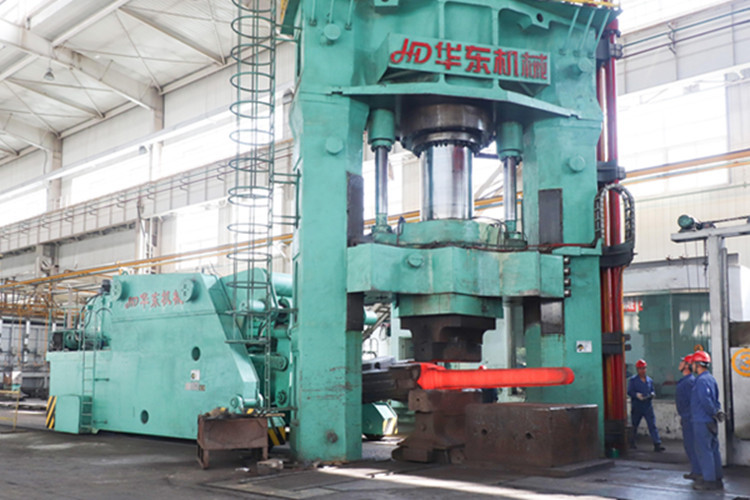
2. Forging Presses
Presses shape metal by applying sustained compressive force rather than repeated impacts.
1) Mechanical Presses: These machines use crank, eccentric, or toggle mechanisms to convert the rotary motion of a motor into the controlled linear motion of the ram. They provide a consistent, predetermined stroke, making them highly efficient for mass production.
2) Hydraulic Presses: These use hydraulic fluid and a piston to drive the ram downward. A key advantage of hydraulic presses is their ability to maintain maximum pressure throughout the entire stroke, which is highly beneficial for forging large, complex, or deep-drawn parts.
3) Screw Presses: These utilize a large vertical screw mechanism to drive the ram. They combine the high-energy impact characteristics of forging hammers with the controlled single-stroke action of presses.
3. Specialized Forging Equipment
Certain applications require specialized equipment designed for specific geometries or processes.
1) Upsetters (Horizontal Forging Machines): These machines are designed for the "upsetting" process, which increases the diameter of a workpiece by shortening its length. They are commonly used to produce headed parts such as bolts, valves, and axles.
2) Ring Rolling Machines: These specialized machines are used to increase the diameter of thick-walled rings while simultaneously reducing their wall thickness. They are widely used to manufacture seamless rings for bearings, gears, and railway wheels.
Selection Criteria
The choice of specific forging equipment depends on various factors, including required production volume, part complexity, material properties, and the dimensional precision required for the final product. For instance, forging hammers are typically preferred for workpieces with simple shapes that require short processing cycles, whereas presses are generally selected for parts with tighter tolerances and more complex shapes that approach the final form (near-net shape).

