- tyler@kirail.com
- +86 15603721115
Forging is generally considered superior to other manufacturing processes such as machining and casting. This is because forging can improve grain structure and create ideal grain flow in parts. But what exactly is grain flow? And why is it so important?
In this article, we will focus on grain structure and how grains form in metals, how forging affects grain structure, and why grain flow in parts is important.
1. What is Grain Structure?
The grain structure of a material refers to how its internal crystal lattice solidifies as it transitions from a molten state to a solid state. The cooling time and the stress and strain experienced during cooling significantly affect the final grain structure.
Each grain has a unique orientation, and the regions between grains are called grain boundaries.
2. Grain Formation in Metals
When a metallic material solidifies from a molten state, it forms a unique grain structure depending on the cooling time, stress, and strain. If this metallic material is subsequently cold-worked, its shape will undergo permanent deformation, resulting in dislocations in the material's grain structure.
These dislocations are tiny "slips" in the material's crystal lattice structure that alter the shape and deformation of the metal under stress or strain. Although these dislocations and the metal's grain structure can only be observed under a high-powered microscope, a large number of dislocations are typically present in metallic materials after cold working.
3. What is Grain Flow?
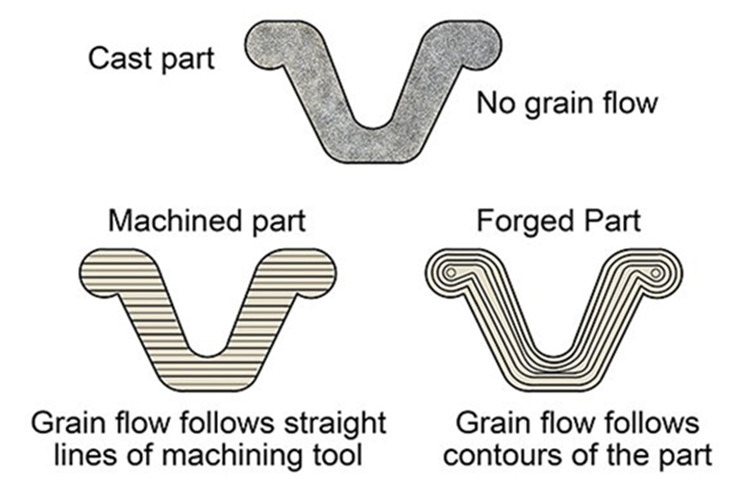
Grain flow refers to the directional alignment of grains during metal deformation.
1) How Grain Flow Affects the Mechanical Properties of Metals Grain flow directly affects the mechanical properties of a material because it determines the direction of the push-pull action of the underlying grains under stress or fatigue.
Cracks are more likely to occur along the grain direction; therefore, the stress direction should be perpendicular to the grain direction. An "ideal" or "optimal" grain flow means that the grain direction aligns with the stress requirements of the forging.
2) Grain Flow in Forging and Other Manufacturing Processes
Forged parts have carefully aligned grains that grow towards maximum strength, resulting in excellent fatigue and impact resistance.
Before forging, the billet must be pre-machined to remove voids created after the metal melts and solidifies. Pre-machined grains are also elongated and longitudinally aligned within the billet, crucial for determining the part's fatigue and impact resistance.
During forging, the metal undergoes controlled deformation at (typically) high temperatures. Compared to other manufacturing processes, forging's advantage lies in its ability to control grain flow. Regardless of the part's geometry, each region maintains a continuous grain flow direction.
To better understand the advantages of forged parts, let's look at two other manufacturing processes: machining and casting.
4. Machining
Machining is typically performed on pre-machined billets that already possess a grain flow direction. However, during machining, the original unidirectional grain flow of the billet is often disrupted, and its profile is altered. Machining exposes grain ends, making the material more susceptible to stress sensitivity, corrosion cracking, and fatigue.
5. Castings
Castings exhibit non-uniform grain structure, grain flow direction, and directional strength. During casting, slurry is poured into a mold, and upon cooling, dendrites form, eventually leading to grains. These grains vary in size, some small, some large, and some very small, resulting in grain boundary voids. The presence of voids in castings signifies very poor impact resistance and fatigue resistance.

