- tyler@kirail.com
- +86 15603721115
1. What is forging?
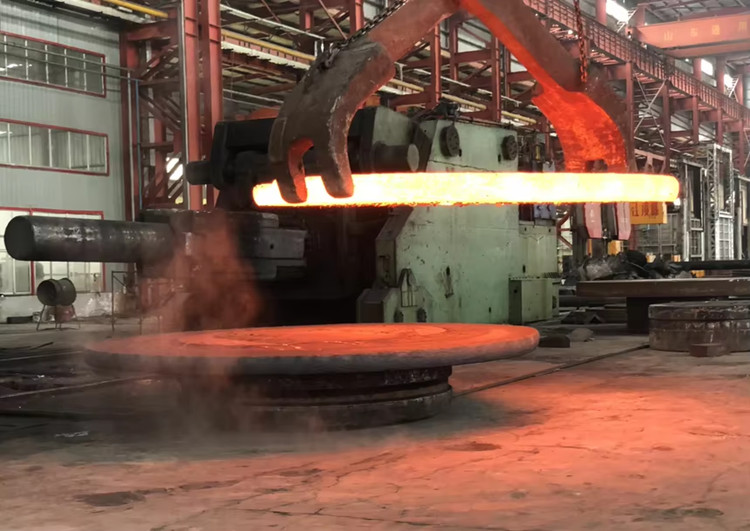
Forging is a manufacturing process that involves hammering, pressing, or rolling metal into a specific shape, such as forged steel. The forging process can be accomplished through hammering, pressing, or using dies. Essentially, it is the process of heating hot metal and shaping it to suit a specific purpose or function.
By processing materials, many properties can be improved, including structure, electrical conductivity, and durability. Forging provides a versatile and cost-effective processing method for numerous industries, achieving specific mechanical properties. Industrial forging is generally classified according to processing temperature as cold forging, warm forging, and hot forging.
2. Forging processes in metal manufacturing
Forgeable materials include carbon steel, alloy steel, tool steel, aluminum, stainless steel, duplex steel, copper, and brass. Industrial forging processes vary depending on various factors; for example, the forging process for titanium differs from that for stainless steel.
When steel is heated to a high temperature of 1200/1300 degrees Celsius, it can be forged into products of various sizes, from small parts weighing 1 kilogram to large forgings weighing 100 tons. During the forging process, the metal grains elongate along the flow direction, significantly improving the metal's toughness. Good design ensures that the flow direction of the finished part coincides with the location where the part bears the greatest stress.
3. The History of Steel Forging
Metal forging is one of the oldest craftsmanship techniques. As early as around 4000 BC, people forged pure metals such as gold and silver into jewelry and weapons. The technique of smelting and forging iron with hammers and anvils is directly related to the 13th and 14th centuries. In the 15th century, with the construction of hammer mills on riverbanks utilizing water flow for forging, metal forging experienced its first major development.
Industrial forging technology has undergone a dramatic transformation. Compared to the era when blacksmiths forged horseshoes with hammers and anvils, today's forging processes are much more precise and complex, resulting in more durable, efficient, and faster engineering solutions. Today, industrial forging companies can produce forgings of various materials, shapes, sizes, and surface finishes.
4. Different Types of Industrial Metal Forging
The concept of forging steel is simple: it involves shaping metal into desired forms, and steel is one of the most in-demand metal components. There are many different types of industrial forging, each with its unique advantages:
1) Open Die Forging
Open die forging refers to forging a material (such as steel) fixed to a flat surface using a hammer. The metal material is not completely constrained or limited by the die. The die continuously strikes the metal material, and a skilled forging operator is responsible for ultimately forging it into the desired shape.
* Better microstructure and improved fatigue resistance
* Machining is usually required to achieve the desired surface finish.
2) Closed Die Forging
Closed die forging, also known as die forging, refers to the process of shaping hot metal using two pre-cut dies to obtain the desired shape. It is important to note that in closed die forging, the dimensions and shape of the heated material are essentially consistent with the dimensions and shape of the final finished part. * Requires less machining and can achieve higher tolerances.
* Requires expensive molds, resulting in very high initial investment costs.
3) Roll Forging
Roll forging involves placing a flat steel bar between two rotating cylindrical rolls, which apply progressive pressure to shape the metal. This process can reduce thickness and increase diameter.
4. Supply of Industrial Forgings under Different Conditions
Forgings are available in various states, from unfinished forgings to finished machined forgings. Machining processes are used to achieve the specific dimensions required for the product. Common machining methods include cutting, boring, turning, drilling, grinding, and milling.
1) What is Black Forging?
Black forging, also known as "unfinished forging," refers to metal that has been formed and heat-treated but has not yet been machined. These forgings retain a black oxide layer on their surface after heat treatment, hence the name. As the name suggests, the material in this process is not machined, only heat-treated.
2) Rough-machined Forgings
Rough-machined forging, also known as "trial machining," refers to the machining of metal to remove the black oxide layer and impart additional properties. Compared to back-forging, rough machining prepares the metal for subsequent machining processes.
3) Semi-machined Forgings
At this stage, the workpiece is initially shaped, but the final finishing work will be completed in subsequent processes. Processes such as tapping, honing, polishing, planing, milling, and reaming are performed, ultimately creating a semi-finished product. Semi-finished products can save customers time, thereby freeing up their production capacity.
4) Finished Machined Forgings
This method achieves the desired dimensions and surface finish. This brings numerous benefits, including improved part quality and enhanced performance. The finished forgings are then tested as needed or prepared for assembly and installation.

