- tyler@kirail.com
- +86 15603721115
What is grain structure?
Grain flow refers to the directional orientation of the metal grains and any inclusions that are deformed by forging. Individual grains are elongated in the direction of metal flow or plastic deformation. More importantly, non-metallic inclusions, particles, and other defects left over from the casting process (forging vs. casting) are elongated in the direction of grain flow. It is important to note that grain flow occurs to some extent in all metal forming processes, not just forging.
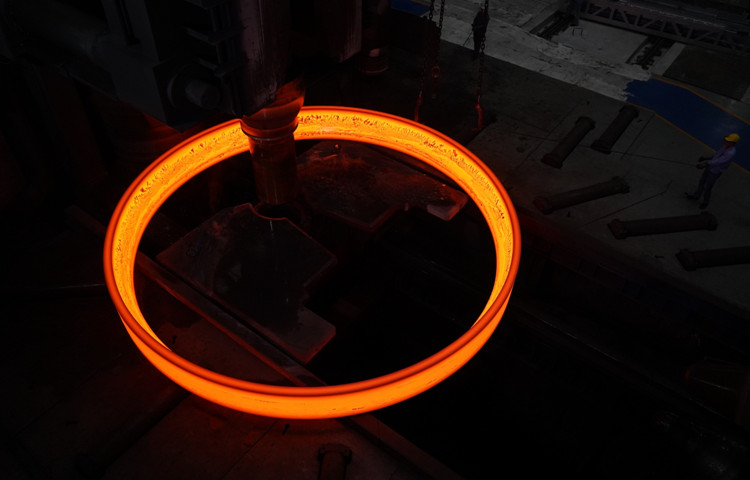
How do grains flow during forging?
Grain flow is observed in this slice of a forging. The slice was cut, polished, and acid etched. The flow lines observed are primarily caused by particles and inclusions left over from the original casting. These particles and inclusions were deformed during billet machining and forging. The forging process also aligns the metal grains in a direction similar to the flow lines in the figure.
Grain flow becomes clearly visible when examining the inside of a forging. The image shows grain flow in a forged and machined component. Observing the grain flow in the figure requires some special preparation methods. After the forging is sectioned, it needs to be ground and polished like a metallographic sample. The main difficulty in this step is that the size of the forging is usually much larger than the small sample used for metallographic analysis. Care must be taken during the preparation process to ensure that the surface is flat and has no bevels. After polishing is completed, an etchant (a solution containing acid) is applied to the polished surface.

