- tyler@kirail.com
- +86 15603721115
In the forging process, the forging ratio, die width ratio, forging temperature, deformation speed, and forging force are the core parameters that determine product quality. They directly affect the microstructure, mechanical properties, and dimensional accuracy of the forgings. The following is a detailed analysis:
1. Forging Ratio: The "conductor" of deformation degree
Definition: The ratio of the cross-sectional area (or length ratio, height ratio) before and after deformation.
Function:
1) Grain refinement: Material strength is improved through multi-pass forging (e.g., forging ratio ≥ 2.5).
2) Defect elimination: Proper control of the forging ratio can reduce internal porosity, shrinkage cavities, and other defects.
3) Application example: The fatigue life of aircraft engine blades was increased by 15% through optimization of the forging ratio.
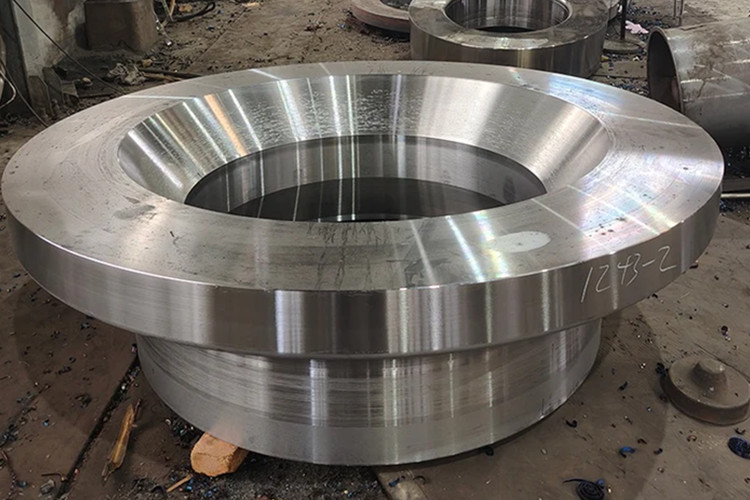
2. Die Width Ratio: The "precision instrument" for size matching
Definition: The matching relationship between the die and the forging size. When full-die feeding is used, it is the ratio of the upper die width to the height of the forging before deformation (η=w/H). When non-full-die feeding is used, it is the ratio of the feed amount to the height (η=L/H).
Function:
1) Compaction effect: When the die width ratio is in the range of 0.6-0.7 and the reduction amount reaches 25%, effective compaction with a relative density of over 0.99 in the core can be achieved.
2) Deformation optimization: Numerical simulation and physical experiments have confirmed that reasonable control of the die width ratio can improve the equivalent strain and hydrostatic pressure distribution.
3. Forging Temperature: The "switch" for fluidity
Definition: The heating temperature during metal forging.
Function:
1) Plasticity control: Too high a temperature leads to coarse grains (overheating), while too low a temperature increases deformation resistance.
2) Process window: For example, the forging temperature for 45 steel is 800-1200℃, and for aluminum alloy it is 350-480℃.
3) Application example: A high-temperature alloy forging device uses a combination of guide rails and scrapers to reduce the time required for manual cleaning of debris.
4. Deformation Rate: The "Rhythm" of Flow
Definition: The rate of metal deformation during the forging process.
Function:
1) Plasticity Reserve: Excessively high strain rates reduce the material's plasticity reserve, while excessively low rates increase cycle time and die sticking.
2) Process Matching: Forging hammers have high impact rates, while mechanical/hydraulic presses have lower rates; dynamic adjustment is required based on material characteristics.
5. Forging Force: The "Power" of Forming
Definition: The pressure applied to the workpiece during forging to induce plastic deformation.
Function:
1) Equipment Selection: Forging force requirements directly influence the selection of forging press tonnage.
2) Process Optimization: Optimizing the forging die's motion trajectory through computer control technology allows for precise forming of complex parts at lower forging forces.
Final Summary
The selection of forging process parameters requires comprehensive consideration of material characteristics, equipment capabilities, and process objectives. By optimizing these key parameters, the quality and production efficiency of forgings can be significantly improved.

