- tyler@kirail.com
- +86 15603721115
What Is Open Die Forging?
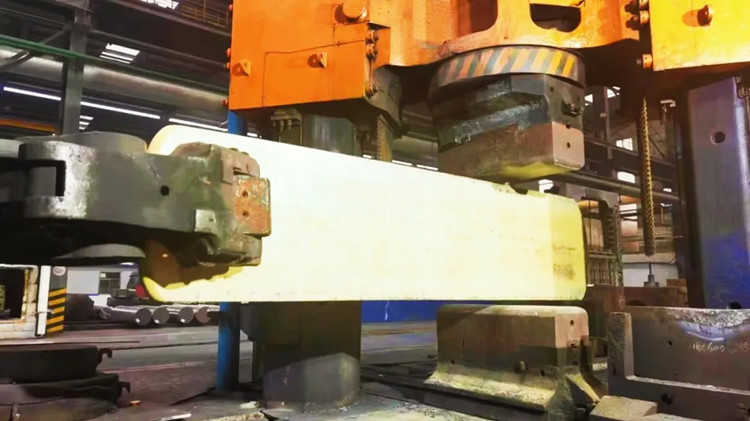
Open die forging—also known as "smith forging"—is a metalworking process in which a heated metal workpiece is shaped between flat or simple dies that do not fully enclose the material. Instead of being forced into a precise, confined cavity, the metal is compressed via hammering or pressing; it is free to flow in directions other than where it makes direct contact with the dies. This method is primarily used to produce large, custom-made, or simple-shaped components that require exceptional structural integrity.
The Open Die Forging Process
The process generally consists of four main steps:
1. Heating: The metal workpiece is heated to a high temperature (typically between 1800°F and 2300°F) to increase its ductility and facilitate deformation.
2. Forging and Deformation: The heated metal is placed between an upper die (attached to a hammer or ram) and a lower die (attached to an anvil or press). The dies apply pressure to the metal, and the workpiece is strategically repositioned between strikes to gradually achieve the desired geometric shape.
3. Heat Treatment: Once forged, the workpiece undergoes heat treatment—such as normalizing, quenching, or tempering—to refine its microstructure and stabilize its mechanical properties.
4. Machining and Inspection: Finally, the forging is machined to its precise, final dimensions and subjected to rigorous inspection to ensure it meets quality and safety standards.
Advantages of Open Die Forging
1. Superior Strength and Durability: The compression process refines the internal grain structure of the metal, thereby increasing its tensile strength and enhancing its resistance to impact. 2. Continuous grain flow: The grain flow of the metal aligns with the shape of the component, which significantly enhances the part's fatigue resistance compared to casting or machining from solid stock.
3. Finer grain size: The repeated deformation process refines the grain structure, thereby improving the overall microstructure.
4. Dimensional flexibility: This process is an ideal manufacturing method for exceptionally large or heavy components that exceed the physical processing capacity of closed-die forging presses.
5. Cost-effectiveness for customized production: By utilizing flat or simple dies rather than complex, purpose-built cavity dies, this process offers shorter lead times and lower tooling costs for small-batch or custom orders.
Applications and Industries
Open-die forging is widely used in industries that demand the highest levels of reliability, durability, and structural performance under extreme stress. Key applications include:
1. Aerospace: Manufacturing rotor and propeller components, landing gear assemblies, shafts, and seamless rolled rings.
2. Power Generation: Producing large industrial shafts, heavy-duty gears, and turbine components.
3. Oil and Gas: Manufacturing high-stress components such as drill collars, valves, and flanges—parts that must withstand high pressure and rigorous fatigue conditions.
4. Heavy Machinery and Mining: Producing large cylindrical components, blocks, and various custom-shaped parts designed to operate under heavy loads, impacts, and vibrations.
5. Defense and Shipbuilding: Forging heavy-duty components that require exceptional structural reliability and high material integrity.
Conclusion
Open-die forging remains an indispensable manufacturing process for producing large, high-strength metal components. Although its dimensional precision may not be as refined as that of closed-die forging, it has become the preferred process for heavy industrial applications, thanks to its advantages in enhancing material properties, accommodating requirements for exceptionally large dimensions, and offering cost-effective, customized solutions.

